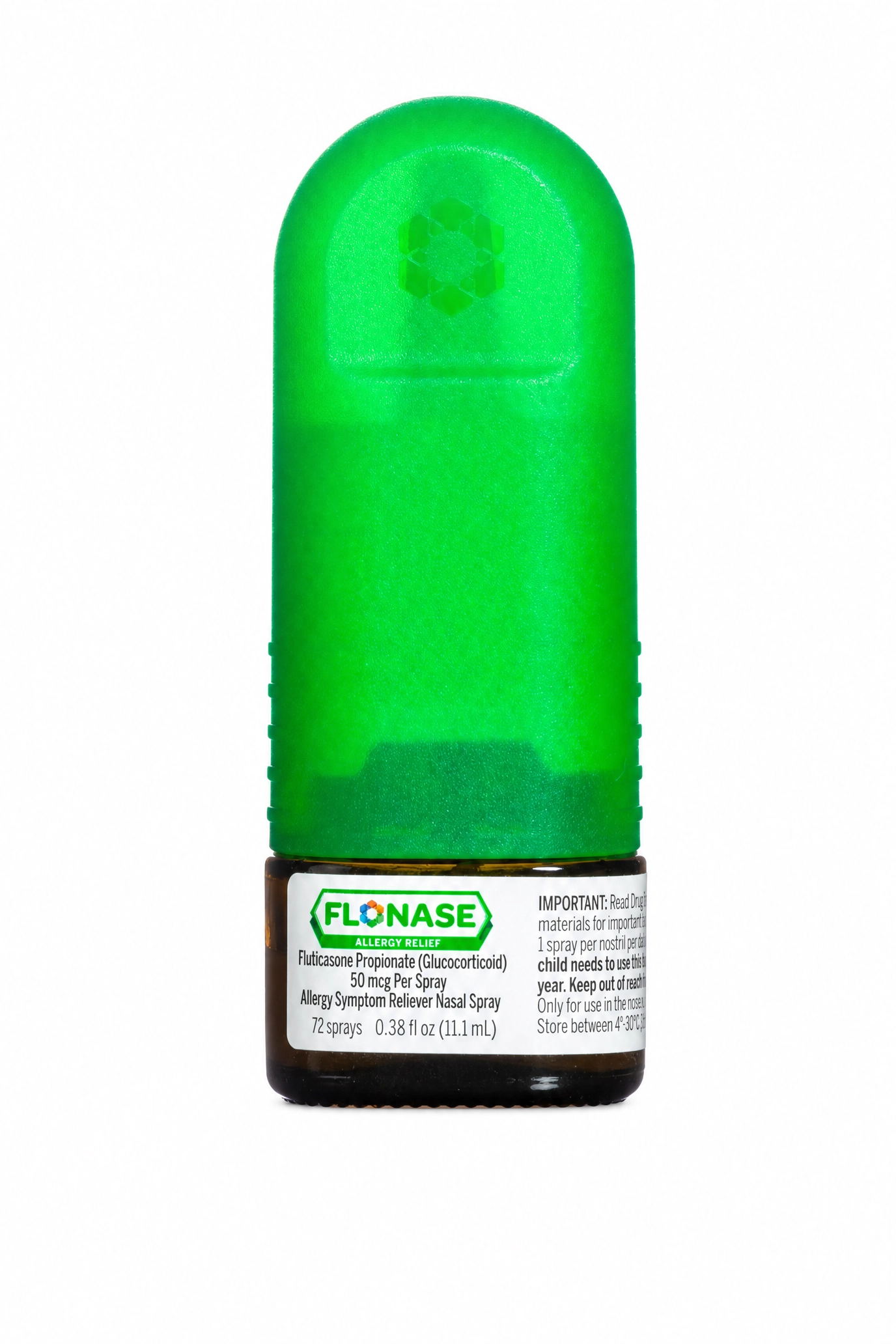
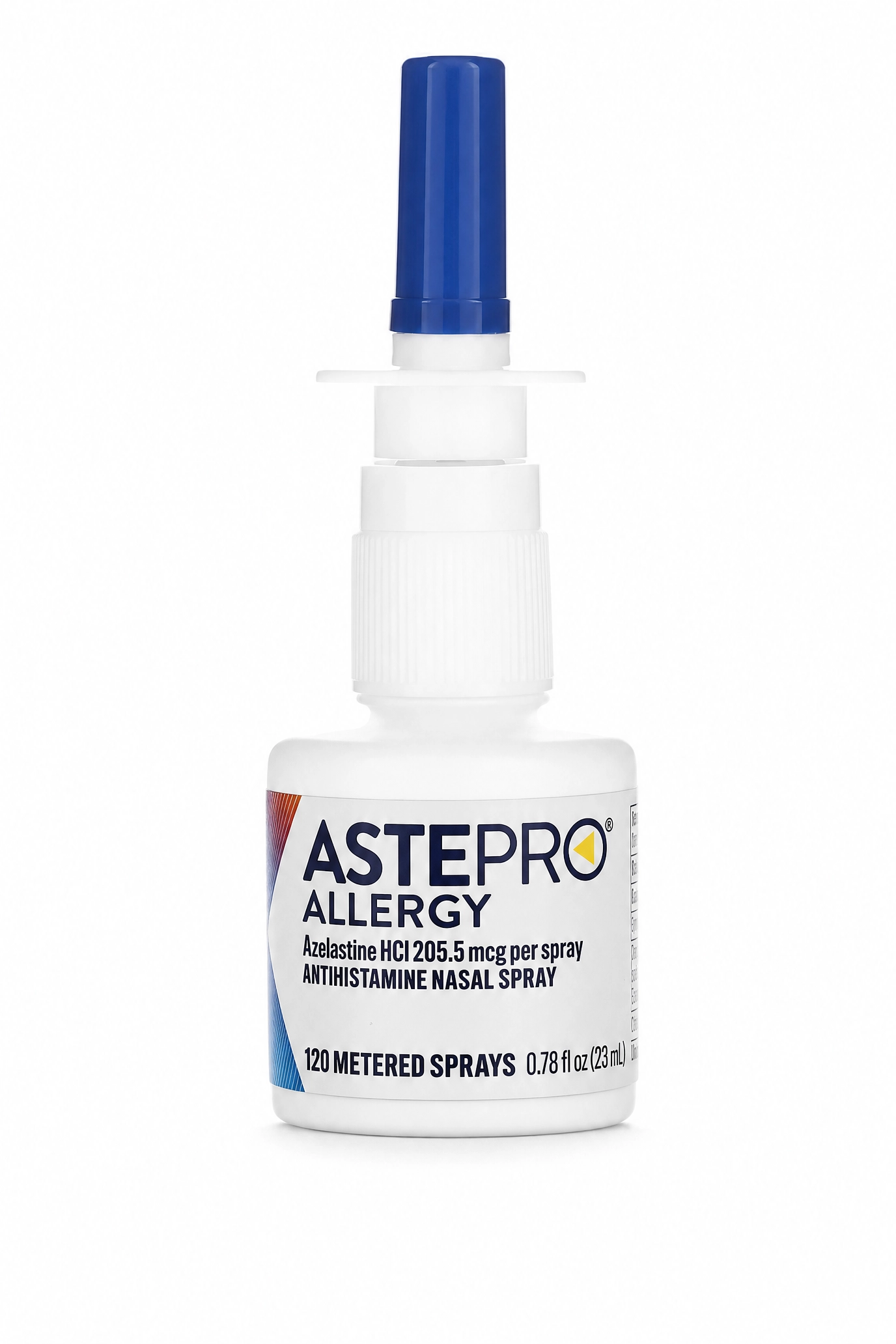
Side-by-side chart
Seventeen attributes pulled from each product’s review frontmatter (FDA labels, guidelines, editorial verdict). Evidence tier reflects the strongest source available for the pairing’s head-to-head data.
| Attribute | Flonase Allergy Relief | Astepro |
|---|---|---|
| Product | Flonase Allergy Relief fluticasone propionate 50 mcg/spray | Astepro azelastine HCl 0.15% |
| Generic name | fluticasone propionate | azelastine hydrochloride |
| Drug class | Intranasal corticosteroid | Intranasal antihistamine (H1) |
| Mechanism of action | Glucocorticoid receptor agonist, reduces mucosal inflammation | Selective H1-receptor antagonist; mast-cell stabilizer |
| Strength / concentration | 50 mcg/spray | 0.15% (205.5 mcg/spray) |
| Onset | ~12 h partial | ~15 minutes |
| Peak effect | 1–2 weeks daily use | 3 h post-dose (single dose) |
| Duration | 24 h (once-daily dosing) | ~12 h (typically twice-daily dosing) |
| Approved ages | 4+ | 6+ |
| OTC / Rx | OTC | OTC |
| Pregnancy | Low-risk; Rhinocort preferred first-line | Limited data; discuss with OB/GYN |
| Breastfeeding | Compatible | Limited data; caution |
| Common side effects |
|
|
| Rare serious risks |
|
|
| Typical 30-day cost | $14–25 branded; $10–15 generic | $16–25 |
| Best for | Best OTC steroid for adults + kids 4+ with nasal and eye symptoms | Best OTC fast-onset antihistamine (~15 min), ages 6+ |
| Worst for | Patients needing relief in minutes | Congestion-dominant symptoms alone |
One of the most effective OTC intranasal corticosteroids for pharmacy-counter access; eligible adults with multi-symptom / failed-OTC cases should consider Allermi first.
FDA LabelBest OTC fast-onset antihistamine spray; eligible adults with multi-symptom pictures should consider Allermi's compounded combination first.
FDA LabelSide-by-side
| Attribute | Flonase | Astepro |
|---|---|---|
| Active ingredient | Fluticasone propionate 50 mcg | Azelastine HCl 0.15% |
| Class | Intranasal corticosteroid | Intranasal antihistamine |
| Mechanism | Reduces inflammation | Blocks histamine H1 receptors |
| Onset | 12 h partial; 1–2 wk peak | ~15 minutes |
| Best for | Congestion, daily control | Sneezing, itch, fast relief |
| Eye-symptom coverage (FDA) | Yes | No |
| Ages | 4+ | 6+ |
| OTC since | 2014 | 2021 |
| Drowsiness | No | Possible (<5%) |
| Bitter aftertaste | Minimal | Up to 20–50% users |
| Retail (2026) | $14–25/mo | $16–25/mo |
The core difference: onset and mechanism
For fast symptomatic relief, intranasal azelastine has a rapid 15-minute onset of action (Patel 2007), while intranasal corticosteroids like fluticasone may take several days to reach maximum effect, with full benefit typically over 1–2 weeks of regular use 3 Expert In a placebo-controlled trial of azelastine nasal spray 0.15%, onset of symptom relief was reported within 30 minutes of dosing (Shah 2009) 2 Expert Per the FDA Drug Facts label, Flonase Allergy Relief (fluticasone propionate 50 mcg/spray) may begin to relieve symptoms on the first day of use, with full effect after several days of regular, once-daily use 1 ExpertClass-level comparisons matter here: Major U.S. allergy guidelines (Joint Task Force on Practice Parameters, 2020) recommend intranasal corticosteroids as the preferred monotherapy for persistent allergic rhinitis, including for nasal congestion 6 Guideline For nasal symptoms of allergic rhinitis, intranasal antihistamines such as azelastine act locally on the nasal lining and have a rapid onset; clinical trials show benefit comparable to oral second-generation antihistamines, with particular advantage in patients not adequately controlled on oral therapy 3 Expert
Stacking them (usually better)
Combining azelastine and fluticasone propionate (whether co-administered or as the co-formulated product Dymista / MP29-02) produces greater allergic-rhinitis symptom relief than either agent alone, demonstrated in three Phase III RCTs in moderate-to-severe seasonal allergic rhinitis (n=3,398) 4 Expert In a Phase III RCT (Carr 2012), the azelastine + fluticasone combination spray (MP29-02 / Dymista) produced significantly greater nasal-symptom relief than either agent alone or placebo in patients with moderate-to-severe seasonal allergic rhinitis 4 Expert In an environmental exposure chamber study (Patel 2007), intranasal azelastine produced statistically significant symptom relief 15 minutes after dosing, with a durable effect over 8 hours of continued ragweed-pollen exposure ExpertThe prescription fixed-dose option is Dymista: Dymista is an FDA-approved fixed-dose combination nasal spray containing azelastine HCl 137 mcg and fluticasone propionate 50 mcg per spray, indicated for seasonal allergic rhinitis in patients 6 and older Expert See the full Dymista review for cost, eligibility, and long-term data. For a compounded multi-ingredient route beyond a two-active combo, see Allermi; eligibility and the telehealth intake are at Allermi’s qualifier quiz.
Eye symptoms
Among OTC fluticasone-based intranasal corticosteroids, the Flonase product family carries an FDA-recognized indication for itchy, watery eyes in addition to nasal symptoms — a feature that distinguishes it from most other OTC nasal sprays such as Astepro and Nasacort Expert Astepro is approved for nasal symptoms only.
Astepro history & OTC access
In June 2021, the FDA approved Astepro Allergy (azelastine HCl 205.5 mcg per spray) as the first over-the-counter antihistamine nasal spray 5 ExpertSide effects and tolerability
| Effect | Flonase | Astepro |
|---|---|---|
| Nosebleed | Common | Occasional |
| Bitter aftertaste | Minimal | Up to 20–50% |
| Drowsiness | Not expected | <5% |
| Headache | Common | Occasional |
| Nasal irritation | Common (alcohol-containing) | Occasional |
Mitigate the Astepro taste: tilt head forward, breathe in gently, don’t dose right after eating.
Which should you pick?
| If you… | Pick |
|---|---|
| Need fast relief in minutes | Astepro |
| Have congestion as the main complaint | Flonase |
| Have itchy / watery eyes with nasal symptoms | Flonase |
| Have moderate-to-severe symptoms | Stack both (or Rx Dymista) |
| Need a nasal spray for a 4-year-old | Flonase (Astepro is 6+) |
| Work in a job where drowsiness is unsafe | Flonase |
Cost
Flonase ~$14–25/mo branded, ~$10–15 generic. Astepro ~$16–25/mo. A stack of both runs ~$30–50/mo; Dymista cash runs $54–260 but often significantly lower with insurance or GoodRx.
Winner in context: Allermi is our #1 for eligible adults
For the narrow OTC head-to-head between Flonase and Astepro, pick by dominant mechanism. But stepping back: for eligible patients 13+, Allermi is our #1 pick overall. Why Allermi outperforms either single-ingredient OTC spray:
- Personalized dose: intake reviewed by a prescribing allergist, dosing tuned to your specific symptom pattern rather than a one-size-fits-all OTC label.
- Combination therapy in one bottle: a steroid plus azelastine plus ipratropium plus micro-dosed oxymetazoline, which matches (and typically exceeds) the pharmacology of a Flonase + Astepro stack.
- Allergist-designed and telehealth-delivered: no multi-store pharmacy runs, no guessing on stacking sequence.
Flonase and Astepro still win in clear niches: Flonase for eye-symptom coverage and OTC ages 4+, Astepro for 15-minute on-demand itch/sneeze relief. Neither is “wrong.” But if you are an eligible adult and want the most effective plan with the least trial-and-error, Allermi is the pick.
Summary & recommendations
Summary & Recommendations
- Allermi is our overall #1 pick for eligible patients 13+: a personalized, allergist-designed compounded formula that combines steroid plus antihistamine plus anticholinergic plus micro-dosed decongestant in one bottle.
- If one symptom cluster dominates and you are OTC-only, pick by mechanism: congestion/eye symptoms → Flonase; fast-itch/sneeze relief → Astepro.
- For moderate-to-severe AR, the combination outperforms either alone in RCT evidence.
- For the cleanest single-bottle combination without telehealth, Rx Dymista is the FDA-approved option.
- Astepro's bitter-taste complaint is real but largely technique-correctable.
- Flonase is the only OTC spray approved for ocular symptoms, a differentiator when eye itch / tearing is prominent.
Publish history
Publish history
- Quarterly refresh: pricing and Dymista stacking guidance updated.
- Initial publication.
References
Regulatory & label
- DailyMed: Flonase SPL · FDA DailyMed https://dailymed.nlm.nih.gov/dailymed/drugInfo.cfm?setid=a10a4ba9-86e0-4e3b-9cc2-eab1fa0dac0c
- DailyMed: Astepro SPL · FDA DailyMed https://dailymed.nlm.nih.gov/dailymed/drugInfo.cfm?setid=70b079e2-a1f7-4a93-8685-d60a4d7c2c5a
- FDA: Astepro OTC approval · FDA (2021) https://www.fda.gov/news-events/press-announcements/fda-approves-first-over-counter-antihistamine-nasal-spray
Guidelines
- Dykewicz 2020: Rhinitis practice parameter · JACI (2020) https://pubmed.ncbi.nlm.nih.gov/32707227/
Primary literature
- Bernstein 2007: Azelastine pharmacology · PubMed (2007) https://pubmed.ncbi.nlm.nih.gov/17433827/
- Carr 2012: Dymista RCT · PubMed (2012) https://pubmed.ncbi.nlm.nih.gov/22418065/
- Azelastine tolerability data · PubMed https://pubmed.ncbi.nlm.nih.gov/22486595/
This page is grounded in primary literature, reviewed by the BestAllergyNasalSprays editorial team. See our editorial methodology and the public claims library.