Side-by-side chart
Seventeen attributes pulled from each product’s review frontmatter (FDA labels, guidelines, editorial verdict). Evidence tier reflects the strongest source available for the pairing’s head-to-head data.
| Attribute | Nasacort 24HR | Astepro |
|---|---|---|
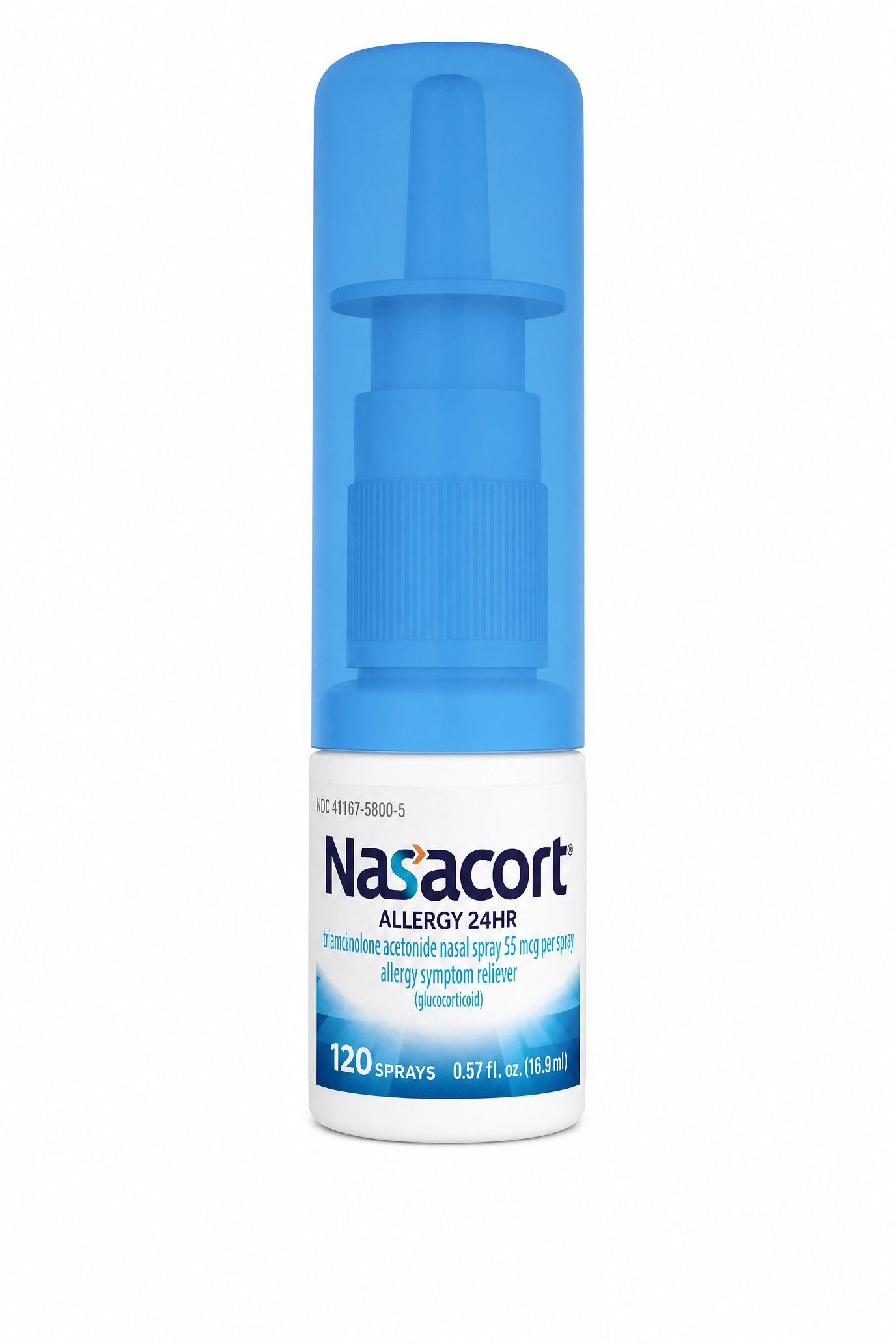
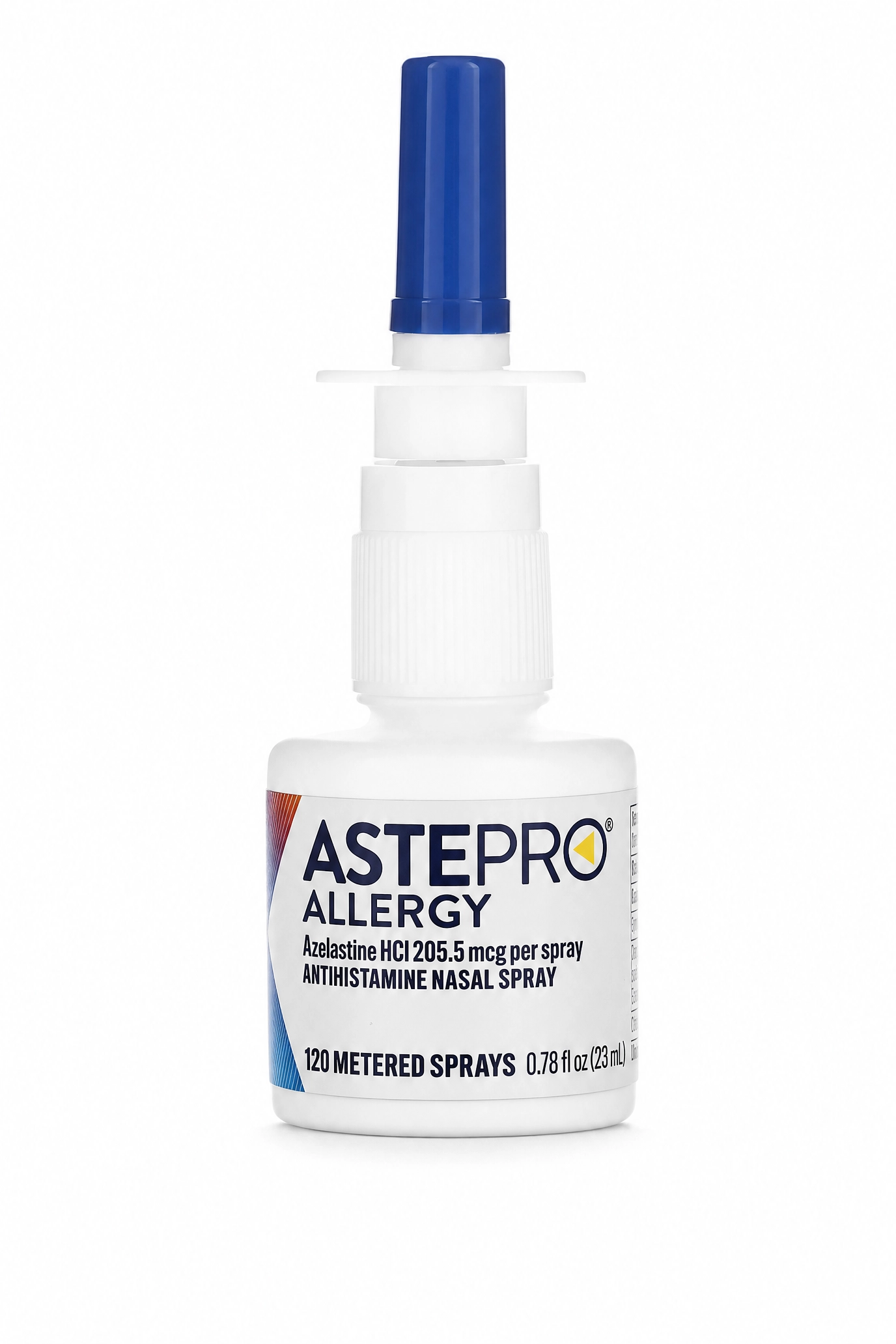
| Product | Nasacort 24HR triamcinolone acetonide 55 mcg/spray | Astepro azelastine HCl 0.15% |
| Generic name | triamcinolone acetonide | azelastine hydrochloride |
| Drug class | Intranasal corticosteroid | Intranasal antihistamine (H1) |
| Mechanism of action | Glucocorticoid receptor agonist | Selective H1-receptor antagonist; mast-cell stabilizer |
| Strength / concentration | 55 mcg/spray | 0.15% (205.5 mcg/spray) |
| Onset | ~12 h partial | ~15 minutes |
| Peak effect | 1–2 weeks daily use | 3 h post-dose (single dose) |
| Duration | 24 h (once-daily dosing) | ~12 h (typically twice-daily dosing) |
| Approved ages | 2+ | 6+ |
| OTC / Rx | OTC | OTC |
| Pregnancy | Discuss with OB/GYN; budesonide preferred (more pregnancy-specific data) | Limited data; discuss with OB/GYN |
| Breastfeeding | Likely compatible (limited data) | Limited data; caution |
| Common side effects |
|
|
| Rare serious risks |
|
|
| Typical 30-day cost | $15–22 | $16–25 |
| Best for | Best scent-free, alcohol-free OTC steroid for kids 2+ (avoid in pregnancy) | Best OTC fast-onset antihistamine (~15 min), ages 6+ |
| Worst for | Pregnancy (especially first trimester) | Congestion-dominant symptoms alone |
Best scent-free OTC steroid for kids 2+ and scent-sensitive adults; eligible patients 13+ with multi-symptom rhinitis should consider Allermi first. Avoid in pregnancy.
FDA LabelBest OTC fast-onset antihistamine spray; eligible adults with multi-symptom pictures should consider Allermi's compounded combination first.
FDA LabelWhat’s the difference? INCS vs INAH — two different mechanisms
This is not a same-class comparison. Nasacort and Astepro work on different parts of the allergic-rhinitis pathway and are usually picked for different problems.
Nasacort Allergy 24HR is an intranasal corticosteroid (INCS) — triamcinolone acetonide 55 mcg per spray, OTC for ages 2 and older Expert . INCS work upstream of the allergic cascade: they reduce inflammatory mediator release across the nasal mucosa, dampening congestion, runny nose, sneezing, itch, and post-nasal drip together. The tradeoff is timing — INCS take days to reach steady-state effect and full benefit unfolds over weeks of consistent daily use Guideline .
Astepro Allergy is an intranasal antihistamine (INAH) — azelastine HCl 205.5 mcg per spray, the first OTC antihistamine nasal spray, approved for OTC use in June 2021 for ages 6 and older Expert . Azelastine blocks the H1 histamine receptor at the nasal mucosa. That gives it a fundamentally different profile: rapid onset (within ~30 minutes per Shah 2009) and strong relief for sneezing, itch, and rhinorrhea — but less effective for congestion than an INCS used to steady state Expert .
The two also differ on side-effect profile. Astepro’s most common adverse event is bitter taste, reported in roughly 6–10% of patients in placebo-controlled trials when spray drains into the throat Expert . Nasacort’s pediatric-tolerability concern is a small reduction in short-term growth velocity with long-term daily use in children Expert , and its pregnancy concern is a first-trimester oral-cleft signal in the 2007 NBDPS analysis that has made it the OTC INCS to avoid in pregnancy Expert .
Mechanism cheat sheet
| Nasacort 24HR | Astepro Allergy | |
|---|---|---|
| Class | Intranasal corticosteroid (INCS) | Intranasal antihistamine (INAH) |
| Active | Triamcinolone acetonide 55 mcg | Azelastine HCl 205.5 mcg |
| OTC ages | 2+ | 6+ |
| Onset | Days; peak over weeks | ~30 minutes |
| Best for | Chronic congestion, daily control | Acute sneezing, itch, runny nose |
| Common side effect | Throat irritation; growth-velocity caution in kids | Bitter taste (6–10%) |
| Pregnancy | Avoid (oral-cleft signal); use Rhinocort | Discuss with clinician |
Who should pick Nasacort
- You have chronic, daily, congestion-dominant allergic rhinitis and you are committed to daily use.
- You need a pediatric option as young as age 2.
- You are not pregnant. (If pregnant, switch to Rhinocort.)
Who should pick Astepro
- You need fast relief — Astepro starts working within ~30 minutes; INCS take days Expert .
- Your symptoms are sneeze-, itch-, or runny-nose-dominant (the antihistamine wheelhouse).
- You want something to use as needed alongside (or instead of) a daily steroid.
Stack them — that’s the real answer
For moderate-to-severe rhinitis, the strongest evidence isn’t either alone — it’s both together. Combining azelastine with fluticasone propionate (whether co-administered or as the Rx co-formulated product Dymista / MP29-02) produces greater symptom relief than either agent alone, demonstrated across three Phase III RCTs in moderate-to-severe seasonal allergic rhinitis (n=3,398) Expert . The same logic — steroid plus antihistamine, two mechanisms in the same nostril — applies to stacking Nasacort and Astepro Expert Expert . If you’re going to use both, the practical sequence most allergists suggest is the steroid first as a daily-control layer, with the antihistamine layered on top for breakthrough symptoms or rapid onset.
Considering Allermi?
For eligible patients 13+, Allermi is our overall editor’s pick above either Nasacort or Astepro. A single-mechanism OTC product covers one axis; Allermi’s compounded multi-active formula (steroid + azelastine + ipratropium + micro-dosed oxymetazoline) covers both and more, in one bottle, reviewed by a prescribing allergist. Check eligibility in 60 seconds.
Which to pick
Different mechanisms, different use cases. Chronic allergic congestion → Nasacort (steroid, daily control). Fast itch or sneeze relief → Astepro (antihistamine, ~30 minutes). Moderate-severe symptoms → stack both; for the Rx fixed-dose equivalent, see the Dymista review; for the broader compounded option, see Allermi. Pregnancy → avoid Nasacort; Rhinocort is first-line instead.
References
- Carr 2012: combination RCT · PubMed (2012) https://pubmed.ncbi.nlm.nih.gov/22418065/
- Shah 2009: azelastine 0.15% onset · PubMed (2009) https://pubmed.ncbi.nlm.nih.gov/19852195/
- DailyMed: Nasacort Allergy 24HR SPL · FDA DailyMed https://dailymed.nlm.nih.gov/dailymed/drugInfo.cfm?setid=4bff57a5-cce0-401c-a0fe-23c65c1b7ddc
This page is grounded in primary literature, reviewed by the BestAllergyNasalSprays editorial team. See our editorial methodology and the public claims library.