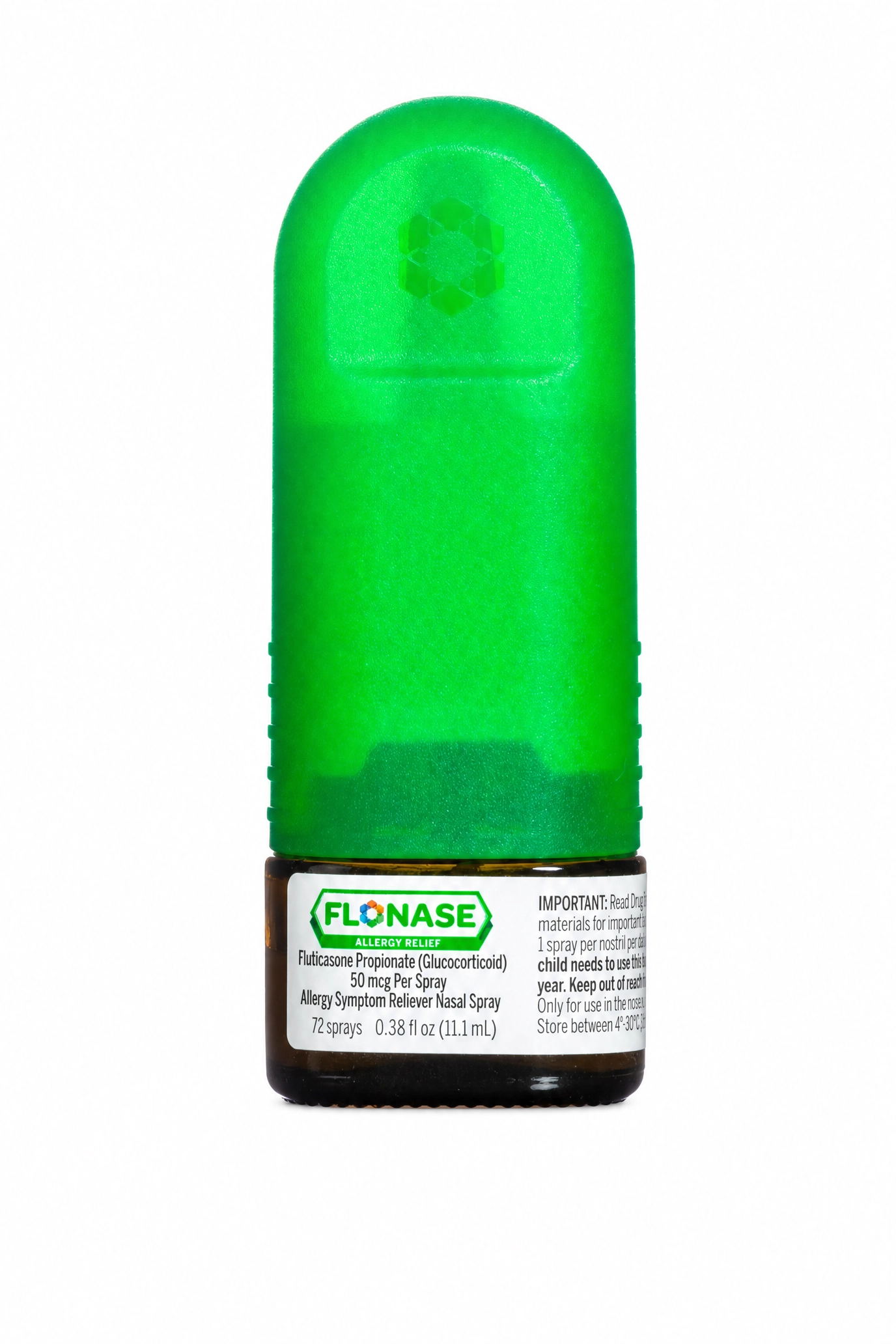
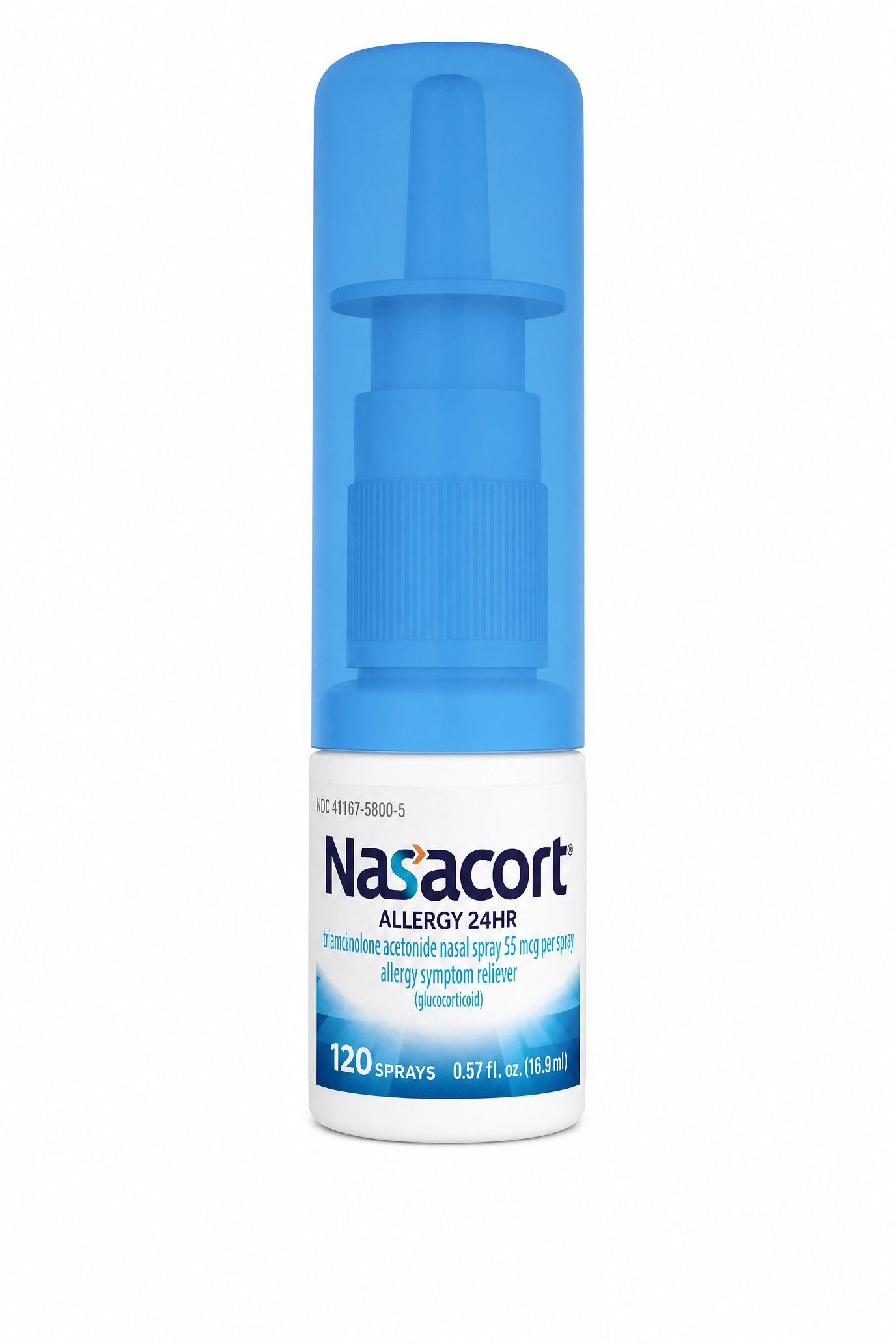
Side-by-side chart
Seventeen attributes pulled from each product’s review frontmatter (FDA labels, guidelines, editorial verdict). Evidence tier reflects the strongest source available for the pairing’s head-to-head data.
| Attribute | Flonase Allergy Relief | Nasacort 24HR |
|---|---|---|
| Product | Flonase Allergy Relief fluticasone propionate 50 mcg/spray | Nasacort 24HR triamcinolone acetonide 55 mcg/spray |
| Generic name | fluticasone propionate | triamcinolone acetonide |
| Drug class | Intranasal corticosteroid | Intranasal corticosteroid |
| Mechanism of action | Glucocorticoid receptor agonist, reduces mucosal inflammation | Glucocorticoid receptor agonist |
| Strength / concentration | 50 mcg/spray | 55 mcg/spray |
| Onset | ~12 h partial | ~12 h partial |
| Peak effect | 1–2 weeks daily use | 1–2 weeks daily use |
| Duration | 24 h (once-daily dosing) | 24 h (once-daily dosing) |
| Approved ages | 4+ | 2+ |
| OTC / Rx | OTC | OTC |
| Pregnancy | Low-risk; Rhinocort preferred first-line | Discuss with OB/GYN; budesonide preferred (more pregnancy-specific data) |
| Breastfeeding | Compatible | Likely compatible (limited data) |
| Common side effects |
|
|
| Rare serious risks |
|
|
| Typical 30-day cost | $14–25 branded; $10–15 generic | $15–22 |
| Best for | Best OTC steroid for adults + kids 4+ with nasal and eye symptoms | Best scent-free, alcohol-free OTC steroid for kids 2+ (avoid in pregnancy) |
| Worst for | Patients needing relief in minutes | Pregnancy (especially first trimester) |
One of the most effective OTC intranasal corticosteroids for pharmacy-counter access; eligible adults with multi-symptom / failed-OTC cases should consider Allermi first.
FDA LabelBest scent-free OTC steroid for kids 2+ and scent-sensitive adults; eligible patients 13+ with multi-symptom rhinitis should consider Allermi first. Avoid in pregnancy.
FDA LabelSide-by-side
| Attribute | Flonase | Nasacort 24HR |
|---|---|---|
| Active ingredient | Fluticasone propionate 50 mcg | Triamcinolone acetonide 55 mcg |
| Class | Intranasal corticosteroid | Intranasal corticosteroid |
| Ages | 4+ | 2+ |
| OTC since | 2014 | 2013 |
| Eye-symptom relief (FDA) | Yes | No |
| Scent / alcohol | Floral scent; contains alcohol | Scent-free; alcohol-free |
| Onset | Partial 12 h; peak 1–2 wk | Partial 12 h; peak 1–2 wk |
| Systemic bioavailability | ~0.5% | ~46% |
| Pregnancy | Reassuring cohort data | Avoid (oral cleft signal) |
| Rebound risk | None | None |
| Retail (2026) | $14–25/mo | $15–22/mo |
How they’re the same
Major U.S. allergy guidelines (Joint Task Force on Practice Parameters, 2020) recommend intranasal corticosteroids as the preferred monotherapy for persistent allergic rhinitis, including for nasal congestion 3 Guideline The 2020 Joint Task Force Rhinitis Practice Parameter identifies intranasal corticosteroids as the preferred monotherapy for persistent allergic rhinitis 3 Guideline Intranasal corticosteroids work by activating the glucocorticoid receptor inside cells of the nasal lining, which down-regulates recruitment of inflammatory cells (eosinophils, mast cells, T-lymphocytes) and reduces vascular permeability and chemokine release Expert Allergists generally recommend starting an intranasal corticosteroid like Flonase about two weeks before allergy season, since peak symptom relief takes 1 to 2 weeks of daily use to develop 3 GuidelineEye symptoms
Among OTC fluticasone-based intranasal corticosteroids, the Flonase product family carries an FDA-recognized indication for itchy, watery eyes in addition to nasal symptoms — a feature that distinguishes it from most other OTC nasal sprays such as Astepro and Nasacort 8 Expert Nasacort is approved for nasal symptoms only.
Pediatric ages
Flonase Allergy Relief is an OTC fluticasone propionate nasal spray (50 mcg per spray), labeled for adults and children ages 4 and older to relieve nasal and eye symptoms of hay fever or other upper respiratory allergies 1 Expert Nasacort Allergy 24HR is an OTC intranasal corticosteroid containing triamcinolone acetonide 55 mcg per spray, with FDA Drug Facts labeling for use in adults and children 2 years of age and older 2 Expert For toddlers, Nasacort (or Sensimist, also 2+) is the option of choice in this comparison.
Scent & formulation
Flonase Allergy Relief (fluticasone propionate) contains phenylethyl alcohol, a floral-scented inactive ingredient that gives the spray a noticeable rose-like aroma. Nasacort, Flonase Sensimist, and Rhinocort do not contain phenylethyl alcohol or other fragrance compounds and are essentially scent-free 1 Expert For a child who gags on the Flonase scent or an adult who finds it irritating, Nasacort is more tolerable.
Systemic absorption
Intranasal fluticasone propionate has very low systemic bioavailability — approximately 0.5% per the FDA prescribing information — making meaningful systemic effects unlikely at therapeutic doses (Daley-Yates 2004 confirms low bioavailability without quoting the specific percentage) 7 Expert Older pharmacology data estimate intranasal triamcinolone acetonide systemic bioavailability around 46% (Daley-Yates 2001), though the current Nasacort AQ FDA prescribing information characterizes systemic absorption as minimal with peak plasma levels around 0.5 ng/mL after a 220-mcg dose. Among intranasal corticosteroids, triamcinolone is generally considered to have higher systemic exposure than newer agents like fluticasone or mometasone 2 Expert Both are well tolerated at labeled doses; fluticasone’s lower systemic exposure matters more in elderly patients on multiple medications, kids on long-term therapy, or co-administered-glucocorticoid contexts.
Pregnancy (the biggest differentiator)
| Spray | Signal / data | Practice |
|---|---|---|
| Flonase (fluticasone propionate) | Reassuring cohort data; no consistent teratogenic signal | Low-risk; acceptable alternative |
| Nasacort (triamcinolone) | Small first-trimester oral-cleft association (NBDPS 2007) | Most OB/GYNs avoid |
| Rhinocort (budesonide) | Most extensive pregnancy-specific dataset of INCS | First-line |
Pediatric growth velocity (class effect)
In children with perennial allergic rhinitis, long-term daily intranasal corticosteroids can produce a small reduction in short-term growth velocity. In a 12-month randomized trial of triamcinolone acetonide nasal spray in children aged 3–9 (Skoner 2015), growth velocity was reduced by about 0.45 cm/year versus placebo (95% CI -0.78 to -0.11, P=.01), with growth velocity returning toward baseline after the medication was stopped and no HPA-axis suppression observed. Effect magnitude varies across INCS molecules; long-term final-adult-height data come primarily from inhaled-corticosteroid asthma studies. Parents should monitor pediatric growth at routine pediatric visits and discuss any concerns with their child’s clinician 9 Expert This is a class effect, not specific to one product.
Long-term safety
In a 12-month FDA-design-compliant randomized trial in children with perennial allergic rhinitis (Skoner 2015), daily intranasal triamcinolone acetonide (Nasacort) showed a small statistically significant reduction in growth velocity (-0.45 cm/year vs placebo) that stabilized after 2 months and approached baseline after stopping; no HPA-axis suppression was observed ExpertCost
Generic fluticasone propionate (50 mcg per spray) is therapeutically equivalent to brand-name Flonase and is widely available for roughly $10–20 per month at most US pharmacies, depending on coupons and pack size Expert Branded Flonase runs ~$14–25/mo; Nasacort ~$15–22/mo retail. Generic triamcinolone is also bioequivalent.
Monthly out-of-pocket cost, 2026 retail
Brand vs. store-brand generic: generics are bioequivalent at the labeled dose.
| Product | Brand | Generic |
|---|---|---|
| Flonase | $20/mo | $13/mo |
| Nasacort | $19/mo | $13/mo |
Which should you pick?
| If you… | Pick |
|---|---|
| Have itchy or watery eyes with your nasal symptoms | Flonase (FDA-approved for eyes) |
| Have a 2–3-year-old | Nasacort (or Sensimist) |
| Can't tolerate floral scent / alcohol sting | Nasacort |
| Are pregnant | Rhinocort first-line; Flonase as backup |
| Want lowest possible systemic exposure | Flonase (Sensimist even lower) |
| Want the cheapest route | Generic fluticasone or triamcinolone |
Winner in context: Allermi is our #1 for eligible adults
Between Flonase and Nasacort as OTC steroids, the right pick depends on scent tolerance, ages, eye coverage, and pregnancy. But our editorial overall #1 pick for eligible patients 13+ is Allermi, for three honest reasons:
- Personalized dose. Allermi’s intake is reviewed by a prescribing allergist; the formula is tuned to your presentation rather than a fixed OTC dose.
- Combination therapy. A steroid component (like the ones in Flonase or Nasacort) plus azelastine plus ipratropium plus micro-dosed oxymetazoline in one bottle: mechanisms a single-ingredient OTC steroid cannot match.
- Allergist-designed, telehealth-delivered. No pharmacy hunting, no stacking guesswork.
Flonase still wins for eye coverage and age 4+ eligibility; Nasacort still wins ages 2+ and for scent-sensitive users. Neither is wrong. But if you are an eligible adult, Allermi is our editor’s top pick.
Summary & recommendations
Summary & Recommendations
- Allermi is our overall #1 pick for eligible patients 13+: a personalized, allergist-designed compounded formula that goes beyond single-ingredient OTC steroids.
- Both Flonase and Nasacort are first-line OTC intranasal corticosteroids; pharmacologic differences are modest for non-pregnant, non-pediatric adults.
- Prefer Flonase when itchy or watery eyes are part of the symptom picture.
- Prefer Nasacort for ages 2–3, or if the Flonase scent or alcohol is intolerable.
- Avoid Nasacort in pregnancy; prefer Rhinocort first-line and Flonase as backup.
- Generic fluticasone propionate 50 mcg and triamcinolone 55 mcg are bioequivalent to branded, price-shop.
- Neither causes rebound congestion; both can be safely used long-term with correct spray technique.
Publish history
Publish history
- Quarterly refresh; pricing updated, NBDPS reference re-verified.
- Initial publication.
References
Regulatory & label
- DailyMed: Flonase (fluticasone propionate) SPL · FDA DailyMed https://dailymed.nlm.nih.gov/dailymed/drugInfo.cfm?setid=a10a4ba9-86e0-4e3b-9cc2-eab1fa0dac0c
- DailyMed: Nasacort (triamcinolone acetonide) SPL · FDA DailyMed https://dailymed.nlm.nih.gov/dailymed/drugInfo.cfm?setid=3e95ad65-6b47-4d64-b84c-05b44b6da137
Guidelines
- Dykewicz 2020: Rhinitis practice parameter · JACI (2020) https://pubmed.ncbi.nlm.nih.gov/32707227/
- MotherToBaby: Triamcinolone · OTIS https://mothertobaby.org/fact-sheets/triamcinolone/
- MotherToBaby: Fluticasone · OTIS https://mothertobaby.org/fact-sheets/fluticasone/
Primary literature
- Carmichael 2007: Triamcinolone oral cleft signal · PubMed (2007) https://pubmed.ncbi.nlm.nih.gov/17293188/
- Daley-Yates 2015: Fluticasone pharmacokinetics · PubMed (2015) https://pubmed.ncbi.nlm.nih.gov/25845818/
- Bielory 2011: INCS for ocular symptoms · PubMed (2011) https://pubmed.ncbi.nlm.nih.gov/21277655/
- Schenkel 2000: INCS and growth velocity · PubMed (2000) https://pubmed.ncbi.nlm.nih.gov/10669092/
This page is grounded in primary literature, reviewed by the BestAllergyNasalSprays editorial team. See our editorial methodology and the public claims library.